
Airplane / Car Rental / Travel Itinerary
Yellowstone National Park, the world’s first national park, is a travel destination that appears on many people’s bucket lists due to its unique natural scenery, where geothermal areas and wildlife ecosystems coexist. It was a place I had always wanted to visit among the national parks in the United States, and I finally fulfilled that long-held desire. The journey began at Bozeman Yellowstone International Airport (BZN), located about a 2-hour drive from Yellowstone National Park. The flight from LAX to BZN took about 2 hours and 35 minutes, making it a relatively easy distance to travel. When preparing for a trip to Yellowstone, many people often transit through Salt Lake City Airport (SLC), which takes about 5 hours by car to reach Yellowstone. In fact, when I compared flight options while booking, I found that SLC had more flights and a wider selection than BZN. Fortunately, I found a flight to BZN that matched my desired schedule, but if your schedule doesn’t align, considering SLC could be a good option.
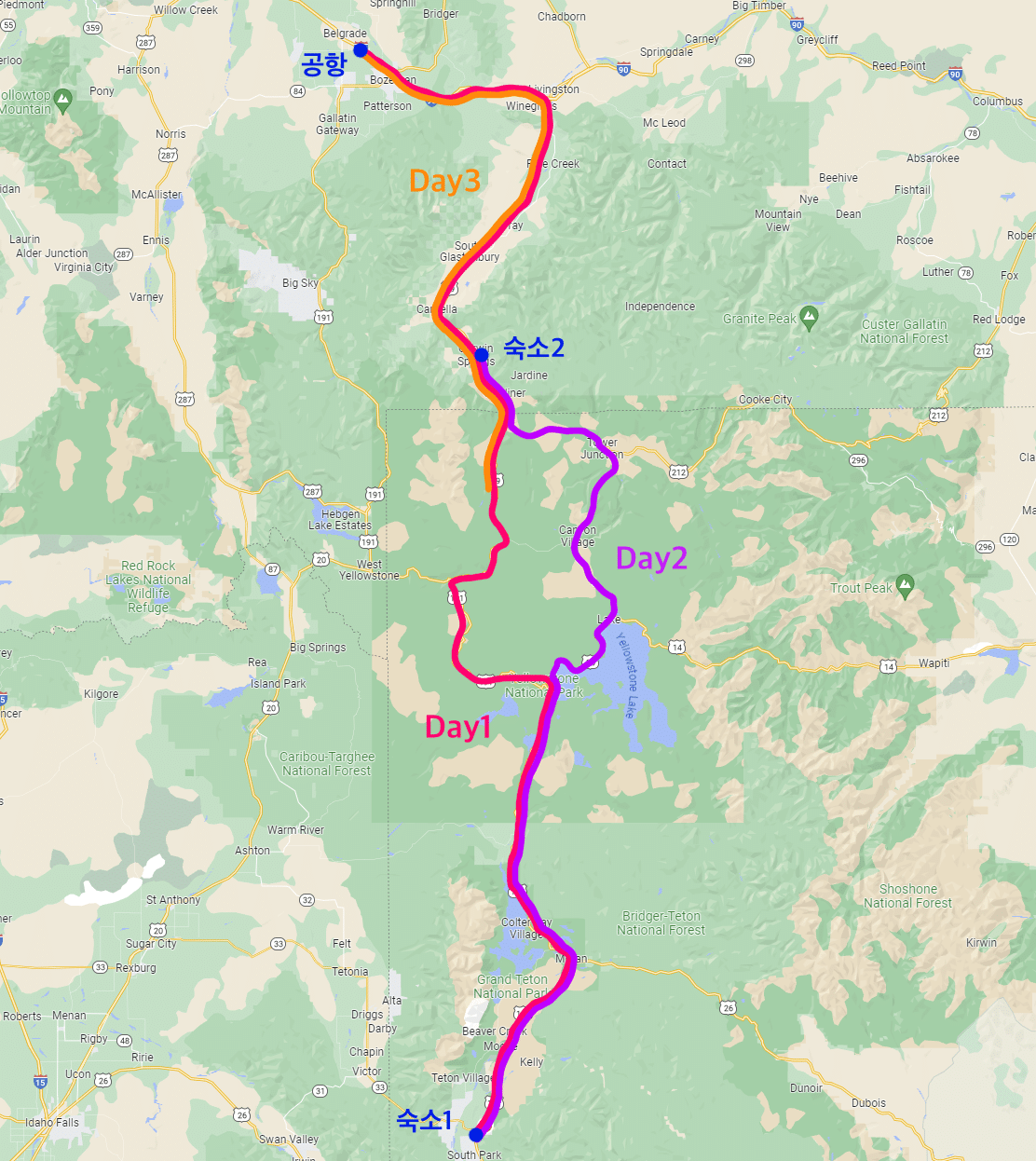


This travel itinerary was based on a route that circles around Yellowstone in the shape of a figure eight, as shown in the photos above. Generally, Yellowstone National Park is often planned around this figure-eight route, and if you have extra time, I would recommend visiting Grand Teton National Park, located just below. I also included this in my itinerary to create a more enriching journey. Although I had to adjust the route slightly due to weather variables, fortunately, I was able to visit all the major attractions I wanted to see.
A rental car is essential for traveling in Yellowstone. We had reserved a vehicle in advance through Enterprise, and upon arriving at the airport, it was clear that most people were heading to Yellowstone, as there were long lines at every rental car booth. In particular, Hertz, Avis, and Budget had extremely long lines, while Enterprise had fewer people waiting, but I still had to wait for a while. With Enterprise, if you complete the online check-in in advance and input all your information, you can receive your vehicle with just a simple signature, saving a lot of time. If you plan to use a rental car, I highly recommend entering your information in advance.
Yellowstone National Park Weather
Even before the trip, I was constantly checking the weather in Yellowstone, as forecasts kept changing from rain to clear skies and then back to cloudy. Honestly, I thought, ‘How much rain could there be?’ but upon arrival, I was met with pouring rain. As shown in the photos, the sky was clear and the weather was perfect when we entered the park, but it wasn’t long before it suddenly started pouring, and even hail fell. The yellow box in the second photo indicates the hail that actually fell on the car. In some areas, there was still snow piled up next to the road, and on the second day, the sun shone brightly only to quickly turn chilly, making it feel like we experienced all four seasons in a single day.


Of course, the weather varies depending on the time of year, but since Yellowstone is at such a high elevation and there are significant climate differences between regions, I recommend bringing a waterproof outer layer. On the second day, I hurriedly bought an outer layer locally and found it very useful.
Gardiner Montana
For this trip, we decided to enter through the North Entrance, one of the several gateways to Yellowstone National Park. The North Entrance is located at the northern edge of the park, and the first town you naturally encounter before entering is Gardiner, Montana. This small town has a nice collection of souvenir shops, local restaurants, cafes, and even a Visitor Center, making it a great place to stop and relax before diving into the main itinerary.


Although it’s not large, it has a charming appeal that makes it enjoyable to explore, and it was enough to soak in the local atmosphere for a while. It was especially perfect for preparing what you need before entering the park or buying a souvenir to commemorate the start of your trip. If you plan to use the North Entrance, a short stop in Gardiner will likely remain a memorable part of your journey.
Norris Geyser Basin
Yellowstone National Park has several geyser areas, but Norris Geyser Basin is known to be the hottest, oldest, and most dynamic of them all. Upon visiting, I immediately realized that this description was not an exaggeration. The area was bubbling with sounds and thick smoke rising from various spots, and getting close to the steam felt like being enveloped in a hot steam sauna. The weather was quite chilly during my visit, but passing by the steam made me feel warm, allowing me to forget the cold for a moment.


The unique sulfur smell of the geysers was subtly present, which personally didn’t bother me much, but my brother mentioned that he found it quite strong, indicating that the perception varies from person to person. Walking through this fascinating yet somewhat tense landscape felt like encountering the energy from deep within the Earth, making it a place that could be remembered as more than just a travel destination.
Old Faithful
The next stop was Old Faithful, one of the iconic attractions of Yellowstone. As the name suggests, it is a geyser that consistently erupts hot spring water at regular intervals, and it is considered a must-see when visiting Yellowstone. When we arrived, many people were already gathered, and finding a parking spot was quite challenging. After circling around a few times, we finally found a place to park, and despite arriving without checking the eruption time due to the hectic movement, we were fortunate that it started erupting about 15 minutes later.


Before the eruption, the hot spring water rose slightly several times and then stopped, creating an atmosphere where people quietly held their breath, waiting for the moment of eruption. Then suddenly, with a loud whoosh, the hot spring water shot up dozens of meters high, creating a truly spectacular scene. Seeing a scene I had only viewed in photos or videos right in front of me brought an indescribable sense of awe and wonder, and it was a moment when I fully felt the natural energy of Yellowstone.
Grand Prismatic Spring
After enjoying Old Faithful, we headed to one of the places I was particularly looking forward to on this trip, the Grand Prismatic Spring. In this area, in addition to the Grand Prismatic Spring, you can also explore various hot spring features such as Excelsior Geyser, Opal Pool, and Turquoise Pool, making it rich in sights within a short distance. In fact, the Grand Prismatic Spring is known to have the most beautiful view from above on the trail, so I originally planned to view it from above, but due to time constraints, I skipped the trail and only admired it up close.


Amidst the thick rising steam, the rainbow-colored hot spring finally unfolded before my eyes. Seeing a landscape I had only seen in photos in person, I was momentarily mesmerized by its vivid colors, scale, and mystery. Of course, the steam made it hard to capture clearly in photos, but the beauty of witnessing it with my own eyes was incredibly impressive and incomparable. I could see people on the opposite trail looking down at the hot spring from a distance, and if I ever return to this place, I definitely want to hike up the trail to overlook the Grand Prismatic Spring from above.
Biscuit Basin Geyser(Sapphire Pool)
After exploring the Grand Prismatic Spring, we headed to our next destination, the Biscuit Basin Geyser. However, as soon as we left the parking lot, I was surprised to see a long line of cars, which was likely caused by many people moving at once after the eruption of Old Faithful. Fortunately, we moved quickly right after the eruption, so we didn’t have to wait long, but if we had been just a bit later, we would have been stuck in traffic for quite a while. If you plan to move to another location right after Old Faithful, it would be good to keep this in mind.


Biscuit Basin Geyser was not a place I had particularly high expectations for, but upon arriving, I was amazed by the beauty of Sapphire Pool. The clear, transparent blue water had a color reminiscent of sapphire, and it was so clean that it was beautiful yet mysterious, making it hard to gauge its depth. It was a place that offered unexpected emotions, and I felt it was definitely worth stopping by, even briefly, while traveling through the area.
West Thumb Geyser Basin
West Thumb Geyser Basin was smaller in scale compared to the geysers I had visited earlier, but it was located right next to the lake, creating a unique landscape. The sight of steam rising close to the water’s edge was impressive, and above all, the variety of colors in the hot springs caught my eye.


In particular, the hot spring in the third photo, aptly named ‘Paint Pot,’ had a mix of red, gray, and yellow hues that resembled spilled paint. It was fascinating to encounter these small yet unique geothermal features. Although I had already seen large and extravagant geothermal areas before, the tranquil lakeside and the unusual terrain made for a pleasant walking route towards the end of my trip.
Mud Volcano & Dragon Mouth Spring
Mud Volcano & Dragon Mouth Spring left a strong impression, just as their names suggest. The two sites were located right next to each other, making it convenient to visit them together. At this point, it started to rain lightly again, so I took out my outerwear and walked slowly. The first sight I encountered, Mud Volcano, was bubbling with mud as the name implies, and the vigorous splashes of mud gave the impression of the Earth’s heart beating. It was so fascinating that I found myself standing there for quite a while, watching.


If you walk a little further up, you will encounter Dragon Mouth Spring, a mysterious place where a loud sound continuously erupts from a cave-like entrance along with steam, truly giving the feeling that a dragon is breathing. It turns out that this sound is caused by steam and gas exploding through water and hitting the cave walls. I thought it was a well-chosen name that captures the characteristics of nature. Compared to other geothermal areas, it had a rougher and more primitive feel, and the sound of the bubbling mud and grand steam made me feel the energy of nature throughout my body.
Roosevelt Arch
On the last day of our trip in Yellowstone, we stopped by Roosevelt Arch, an arch designed by the famous architect Robert Reamer in 1903. It was named after President Theodore Roosevelt, who attended the groundbreaking ceremony during his visit to Yellowstone at that time.


We had seen this place bustling with people the day before as we passed by on our way back to our accommodation, but when we returned early on the last day, it was quiet and serene, making it perfect for taking photos. I realized once again that starting the day early is a tip for enjoying the trip more leisurely and comfortably, as people tend to gather at popular spots if you move even a little late. Walking under the stone structure that bears the marks of time, I felt a connection between the beginning and end of this journey, and Roosevelt Arch remained in my memory as a symbolic place beyond just an entrance.
Mammoth Hot Springs
Mammoth Hot Springs was a place we had passed several times on the first day of our trip and on the day we returned to our accommodation, but we had postponed our visit to the last day of the trip after hearing that it would take a relatively long time. The morning air was chilly, but as we walked, my body quickly warmed up, making it a perfect day for a stroll.


As I started walking along the course, I encountered a much more diverse range of terrains and landscapes than I had expected. The first point, Devil’s Thumb, was impressive with its layers of pure white limestone. The snow-covered terrain combined with the lush green forest created an almost surreal feeling, and the steam rising from the geothermal features added vibrancy to the scene. The next stop, Minerva Terrace, had some sections closed off, requiring us to take a detour, but this allowed us to appreciate the scenery from different angles.


The third point was Mound Spring. The slope was quite steep, making the ascent challenging, but as soon as I arrived, the view was so stunning that I couldn’t help but think, “Wow, I’m glad I made the climb.” The steam rising between the terraced formations looked like a natural sculpture created by nature.


Finally, the New Blue Spring offered a tranquil atmosphere that contrasted with the intense geothermal areas I had seen earlier. A little further up from here, there was a path leading to the Upper Terraces, and I occasionally saw people coming down from the parking area above. We only explored the Main Terrace section, but it took about an hour to return to the parking lot, and starting early in the morning allowed us to enjoy a relatively quiet visit. Although the trail was not very easy due to the many stairs, the breathtaking views made each step feel light.
Yellowstone National Park North Entrance
This journey in Yellowstone National Park was a time to encounter the grandeur of nature, the ever-changing weather, and the geothermal areas, each with its own character. Every moment was new and impressive, and above all, it was a trip where I could fully feel the wonders that nature provides. In the next post, I will share stories about Grand Teton National Park, as well as accommodations and dining, so please join me for the upcoming travel moments.
